
Fractions, decimals and the number line
Many ways to write the same number
Three quarters of a pizza can be written as 3/4 = 6/8 = 75/100 = 0.75 = 75%. They're all the same amount — equivalent representations.
Equivalent fractions
- Multiply or divide the top (numerator) and bottom (denominator) by the same number: 3/4 = (3 × 2)/(4 × 2) = 6/8
- To simplify, divide both by their highest common factor: 18/24 → divide by 6 → 3/4
Mixed numbers and improper fractions
2 1/3 means 2 and 1/3. As an improper fraction: 2 wholes = 6 thirds, plus 1 third = 7/3. Going back: 17/4 = 17 ÷ 4 = 4 remainder 1 = 4 1/4.
Fractions to decimals and back
- A fraction is a division: 3/8 = 3 ÷ 8 = 0.375
- Some never end: 1/3 = 0.333… (the 3 repeats forever)
- Decimal to fraction: read the place value. 0.6 = 6/10 = 3/5; 0.45 = 45/100 = 9/20
Negative fractions and decimals on the number line
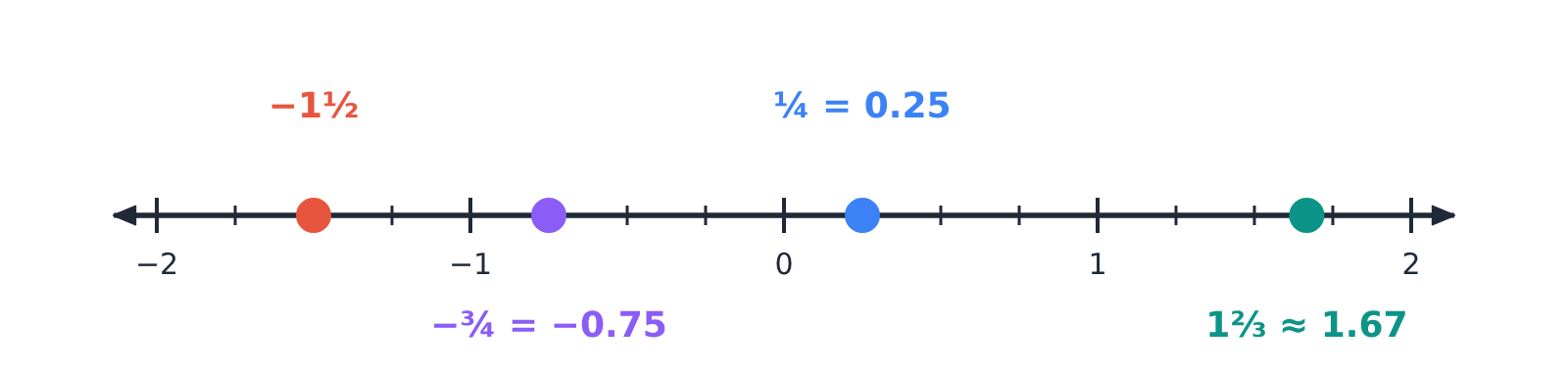
To compare, change them to the same form (decimals are easiest). −3/4 = −0.75 is left of −1/2 = −0.5, so −3/4 is smaller.
Worked example: ordering
- Order 0.7, 2/3, 3/4, 0.65 from smallest to largest.
- Change to decimals: 0.7, 0.666…, 0.75, 0.65
- Order: 0.65, 2/3, 0.7, 3/4
Your turn
Use a pencil and paper. The answers are at the bottom of the page — try first!
- Simplify 15/20.
- Write 2 3/5 as an improper fraction.
- Write 17/4 as a mixed number.
- Write 7/8 as a decimal.
- Write 0.6 as a fraction in simplest form.
- Which is greater: −2/5 or −1/2?
Answers
- 3/4 (divide both by 5)
- 13/5
- 4 1/4
- 0.875
- 3/5
- −2/5, because −0.4 is to the right of −0.5
For parents and teachers — this lesson covers the Victorian Curriculum Mathematics Version 2.0, Level 7:
- VC2M7N03: find equivalent representations of rational numbers and represent positive and negative rational numbers and mixed numbers on a number line
Downloads
2 files to download once you enrol.