
Area of rectangles, triangles and parallelograms
Where the formulas come from
Area is the space inside a flat shape, measured in square units: cm², m², km². A rectangle 8 cm long and 5 cm wide holds 5 rows of 8 one-centimetre squares — 40 cm².
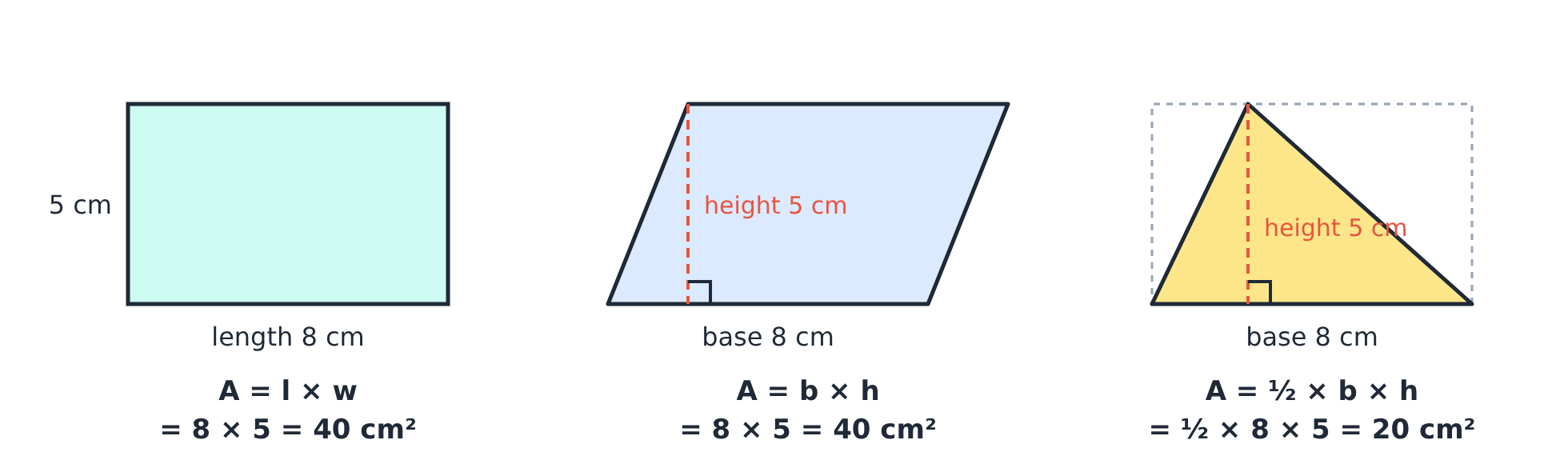
- Rectangle: A = l × w
- Parallelogram: cut the triangle off one end and slide it to the other end — it becomes a rectangle with the same base and height. So A = b × h
- Triangle: two copies make a parallelogram (or the triangle fills half of the dashed rectangle). So A = ½ × b × h
The height must be perpendicular (at 90°) to the base — the red dashed line, not the sloping side.
Worked example: mulching a garden bed
- A triangular garden bed has a base of 6 m and a perpendicular height of 3.5 m. One bag of mulch covers 2 m². How many bags?
- Area = ½ × 6 × 3.5 = 10.5 m²
- Bags = 10.5 ÷ 2 = 5.25
- You can't buy part of a bag, so round up: 6 bags
Working backwards
A triangle has an area of 24 cm² and a base of 8 cm. Its height? ½ × 8 × h = 24, so 4h = 24 and h = 6 cm.
Your turn
Use a pencil and paper. The answers are at the bottom of the page — try first!
- Area of a rectangle 9 cm by 6 cm.
- Area of a triangle with base 10 cm and height 7 cm.
- Area of a parallelogram with base 12 m and height 4.5 m.
- A triangle has area 24 cm² and base 8 cm. Find its height.
- A classroom floor is 8 m by 6.5 m. Carpet tiles cover 0.25 m² each. How many tiles are needed?
Answers
- 54 cm²
- ½ × 10 × 7 = 35 cm²
- 54 m²
- 6 cm
- 52 m² ÷ 0.25 = 208 tiles
For parents and teachers — this lesson covers the Victorian Curriculum Mathematics Version 2.0, Level 7:
- VC2M7M01: establish the formulas for areas of rectangles, triangles and parallelograms and use these in problem-solving
Downloads
2 files to download once you enrol.