
Square numbers and square roots
Numbers that make squares
Arrange counters in a square: 1 counter, then 2 rows of 2, then 3 rows of 3… The number of counters each time is a square number.
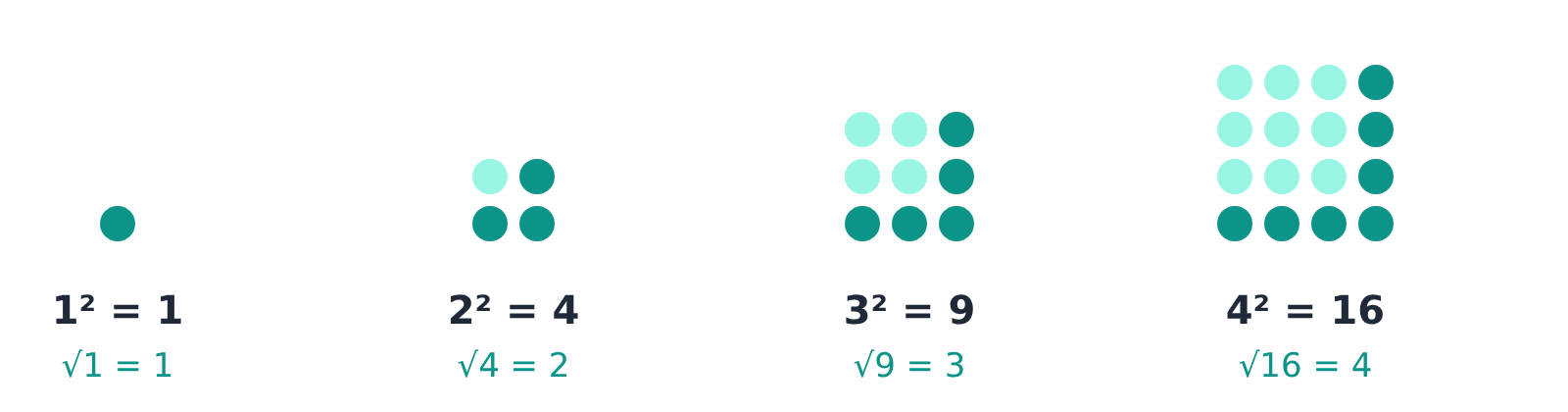
We write "3 squared" as 3², and it means 3 × 3 = 9. The small 2 says "multiply the number by itself".
| n | 1 | 2 | 3 | 4 | 5 | 6 | 7 | 8 | 9 | 10 | 11 | 12 |
|---|---|---|---|---|---|---|---|---|---|---|---|---|
| n² | 1 | 4 | 9 | 16 | 25 | 36 | 49 | 64 | 81 | 100 | 121 | 144 |
These are the perfect squares. Learning them up to 12² makes lots of Year 7 maths faster.
Square roots: going backwards
The square root of a number asks: "which number, multiplied by itself, makes this?" The symbol is √.
- √49 = 7, because 7² = 49
- √144 = 12, because 12² = 144
- Squaring and square-rooting undo each other: √(6²) = 6
Common mistake: 3² is not 3 × 2 = 6. It's 3 × 3 = 9.
Numbers that aren't perfect squares
√50 isn't a whole number. But 49 < 50 < 64, so √50 is between √49 = 7 and √64 = 8 — and closer to 7. (A calculator says 7.07…)
Worked example: a square garden
- A square vegetable garden has an area of 64 m². How much fencing goes around it?
- The side length is √64 = 8 m, because 8 × 8 = 64.
- A square has 4 equal sides, so the fence is 4 × 8 = 32 m.
Your turn
Use a pencil and paper. The answers are at the bottom of the page — try first!
- Work out 9².
- Work out √121.
- Which of these are perfect squares: 36, 50, 81, 90?
- A square tile has an area of 400 cm². How long is each side?
- Between which two whole numbers is √30?
Answers
- 9² = 9 × 9 = 81
- √121 = 11, because 11 × 11 = 121
- 36 (6²) and 81 (9²)
- √400 = 20 cm
- 5 and 6, because 25 < 30 < 36
For parents and teachers — this lesson covers the Victorian Curriculum Mathematics Version 2.0, Level 7:
- VC2M7N01: describe the relationship between perfect square numbers and square roots, and use squares of numbers and square roots of perfect square numbers to solve problems
Downloads
2 files to download once you enrol.