
Classifying triangles and quadrilaterals
Triangles: by sides and by angles
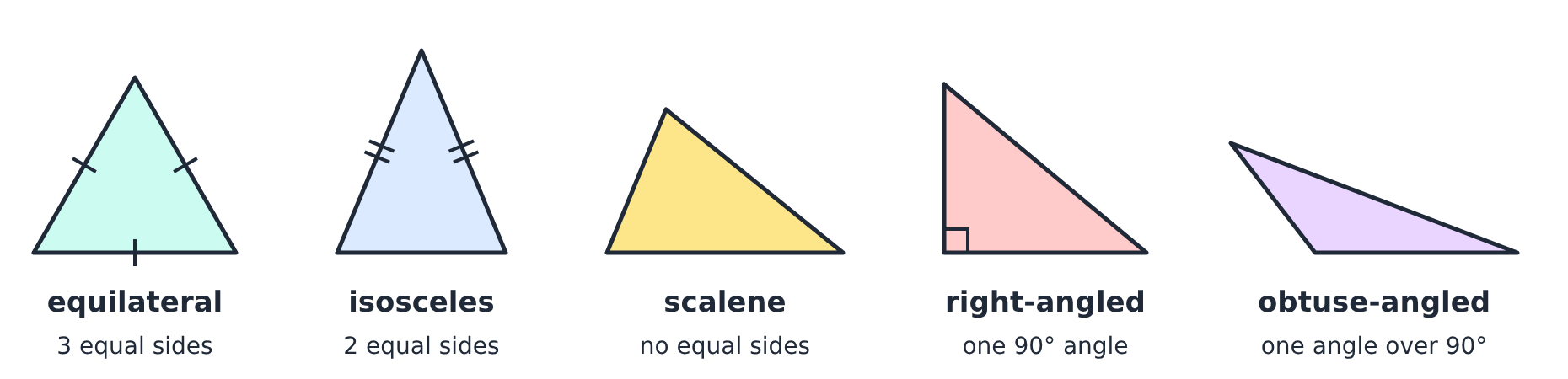
Matching dashes show equal sides. A triangle gets a name for its sides and one for its angles: a triangle with angles 90°, 45°, 45° is a right-angled isosceles triangle. A triangle with all angles under 90° is acute-angled.
Quadrilaterals
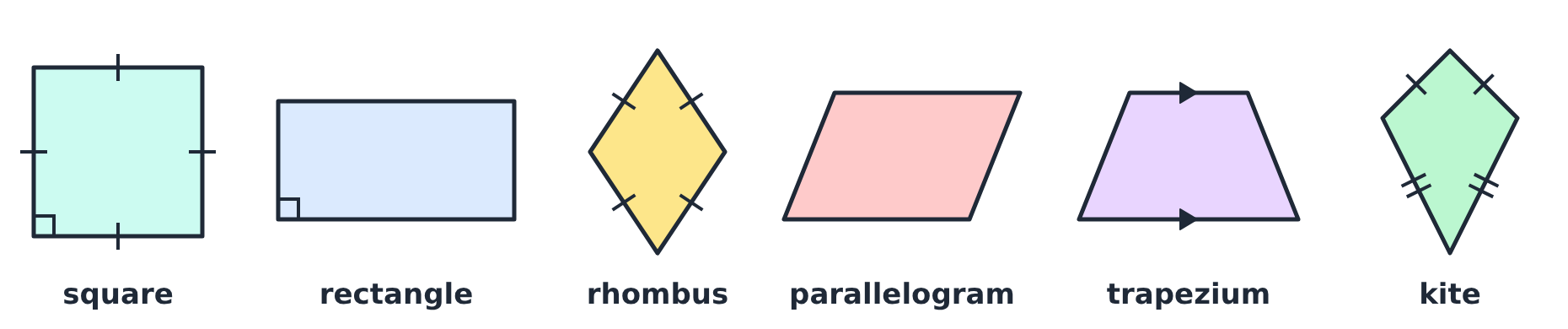
| Shape | Sides | Angles | Parallel sides |
|---|---|---|---|
| Square | 4 equal | 4 right angles | 2 pairs |
| Rectangle | opposite sides equal | 4 right angles | 2 pairs |
| Rhombus | 4 equal | opposite angles equal | 2 pairs |
| Parallelogram | opposite sides equal | opposite angles equal | 2 pairs |
| Trapezium | — | — | 1 pair |
| Kite | 2 pairs of equal sides next to each other | one pair of opposite angles equal | none |
Shapes belong to families. A square has everything a rectangle has (4 right angles) and everything a rhombus has (4 equal sides) — so every square is a rectangle and a rhombus. All of them are parallelograms. But not every rectangle is a square.
An algorithm to sort quadrilaterals
An algorithm is a set of steps with decisions. Follow it for any quadrilateral:
- Are there 2 pairs of parallel sides? If no, go to step 5
- Are all angles right angles? If yes: are all sides equal? Yes → square. No → rectangle. Stop
- Are all sides equal? Yes → rhombus. Stop
- Otherwise → parallelogram. Stop
- Is there exactly 1 pair of parallel sides? Yes → trapezium. Stop
- Are there 2 pairs of equal sides next to each other? Yes → kite. No → just a quadrilateral
Test it on each shape in the picture. Notice the order matters: checking for squares before rectangles stops a square being called "just a rectangle". This is the same kind of thinking programmers use.
Your turn
Use a pencil and paper. The answers are at the bottom of the page — try first!
- A triangle has sides 5 cm, 5 cm and 8 cm. Name it by its sides.
- A triangle has angles 30°, 60° and 90°. Name it by its angles and sides.
- A triangle has angles 20°, 40° and 120°. Name it by its angles.
- A quadrilateral has 4 equal sides but no right angles. What is it?
- True or false: every square is a rectangle.
- True or false: every rectangle is a square.
Answers
- Isosceles
- Right-angled scalene
- Obtuse-angled
- A rhombus
- True — it has 4 right angles and opposite sides equal
- False — its sides don't have to be all equal
For parents and teachers — this lesson covers the Victorian Curriculum Mathematics Version 2.0, Level 7:
- VC2M7SP02: classify triangles, quadrilaterals and other polygons according to their side and angle properties; identify and reason about relationships
- VC2M7SP04: design algorithms involving a sequence of steps and decisions that will sort and classify sets of shapes according to their attributes, and describe how the algorithms work
Downloads
2 files to download once you enrol.