
Machine Learning Basics with Python
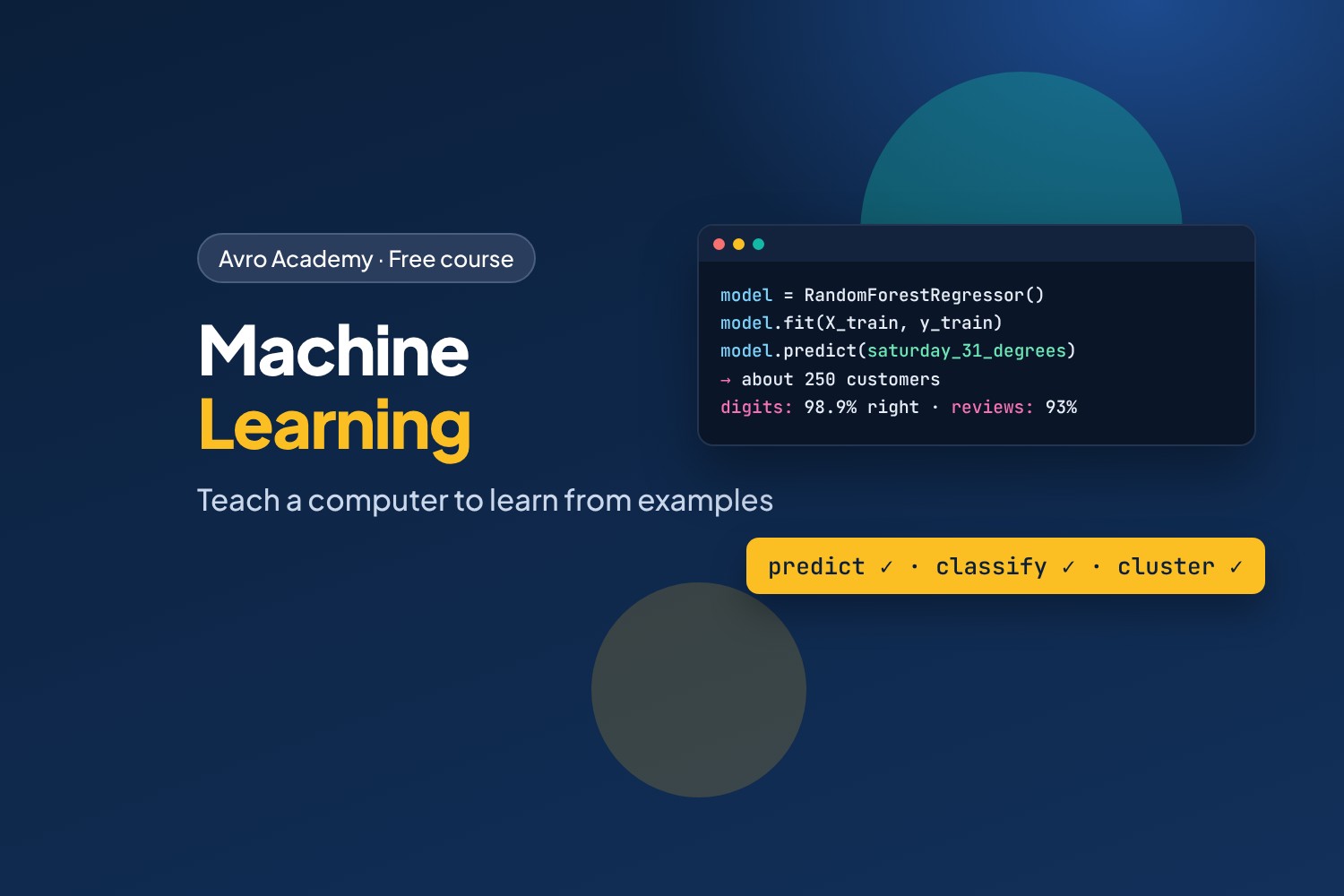
Teach a computer to learn from examples: predict how busy the café will be, who'll come back, whether a review is happy, and which digit someone wrote — with Python and scikit-learn.
How computers learn from examples
Machine learning is behind recommendations, spam filters, fraud alerts, weather apps and the AI chatbots everyone talks about. Underneath, it's one idea: show a computer lots of examples, and let it find the pattern — instead of writing every rule by hand.
In this course you'll use Python and scikit-learn, the most widely used machine learning library, to answer real questions for Corner Café: How many customers will come on Saturday? Which loyalty members are about to stop coming? Is this review happy or unhappy? What groups of customers are there? And you'll teach a model to read handwritten digits.
What you'll learn
- What machine learning is, and the main kinds: regression, classification and clustering
- Preparing data: features, labels, missing values and text categories
- Training and testing models properly, and measuring how good they are
- Linear and logistic regression, decision trees and random forests
- Working with text and images
- Avoiding overfitting, cross-validation and pipelines
- Saving a model and using it in a program — and using ML responsibly
Before you start
You should be comfortable with Python basics (Python Foundations). Python for Data (pandas) helps a lot. No maths beyond Year 10 — we explain every idea in plain words.
How it works
- 6 modules, 18 lessons, about 7 hours including quizzes
- Every script, result and chart in the lessons was run for real
- The café's data and the finished scripts, a quiz after each module, a cheat sheet and a certificate
Free forever — like every self-paced course on Avro Academy: all lessons, quizzes, downloads and your certificate. Our promise
Course outline
Module 1: Meet machine learning
What machine learning is, setting up Python and scikit-learn, and your first model.
- What machine learning isFree preview20 min
- Set up your tools20 min
- Your first model25 min
- Module 1 quiz5 min
Module 2: Preparing data
Exploring data, features and labels, missing values, one-hot encoding, and splitting into training and test sets.
- Explore the data first25 min
- Features and labels25 min
- Train and test25 min
- Module 2 quiz5 min
Module 3: Predicting numbers
Linear regression, measuring models with baselines, MAE, RMSE and R², and decision trees and random forests.
- Linear regression30 min
- How good is the model?30 min
- Decision trees and random forests35 min
- Module 3 quiz5 min
Module 4: Predicting categories
Logistic regression, confusion matrices, precision and recall, choosing cut-offs, and classifying text.
- Will they come back?30 min
- Accuracy isn't everything35 min
- Reading reviews35 min
- Module 4 quiz5 min
Module 5: Images, groups and good habits
Recognising handwritten digits, clustering customers with KMeans, cross-validation and pipelines.
- Recognising handwritten digits30 min
- Finding groups of customers30 min
- Cross-validation and pipelines30 min
- Module 5 quiz5 min
Module 6: Using models responsibly
Saving and using a model, keeping it working, bias, fairness and privacy, and where to go next.
- Save and use your model30 min
- Using machine learning responsibly25 min
- Where to go next20 min
- Module 6 and final quiz5 min